Published on: March 3, 2026
Category: AML

If you operate in any of the following sectors, the Tranche 2 AML/CTF reforms are directly relevant to your business:
🏠 Real estate and property services
⚖️ Law firms and legal practices
📊 Accounting and advisory firms
🧾 Conveyancers and settlement agents
🏢 Trust and company service providers (TCSPs)
💎 Dealers in precious metals, stones and high-value goods
From 1 July 2026, many firms across these industries will be brought into Australia’s AML/CTF regime for the first time
The question is no longer whether AML obligations are expanding.
The question is:
How should firms in scope prepare — strategically, proportionately and without operational disruption?
The common risk profile across these industries includes:
🔁 Facilitating asset transfers
🏗 Creating or restructuring legal entities
💰 Handling client funds
🧩 Supporting complex ownership structures
📈 Managing high-value transactions
These activities sit at key points where financial crime risk can emerge.
Tranche 2 expands the regulatory perimeter to professional intermediaries involved in structuring and transferring wealth.
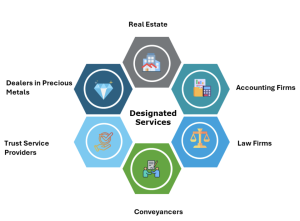
Diagram1: Sectors in Scope
Although the trigger is activity-based, the operational impact differs by profession.
🏠 Real Estate & Property Services
Likely captured where firms:
Operational impact:
📋 Identity checks may move earlier in the onboarding process.
🔍 Greater scrutiny of funding sources.
⚖️ Law Firms & Legal Practices
Likely captured where firms:
Operational impact:
🗂 AML checks integrated into matter intake.
💼 Trust account processes reviewed for escalation controls.
📊 Accounting & Advisory Firms
Likely captured where firms:
Operational impact:
🧠 Clear distinction between advisory vs execution services.
📑 Formalised client verification procedures.
🧾 Conveyancers & Settlement Agents
Likely captured where firms:
Operational impact:
🔐 Beneficial ownership verification becomes routine.
📁 Structured record-keeping required.
🏢 Trust & Company Service Providers (TCSPs)
Likely captured where firms:
Operational impact:
⚠️ Higher baseline risk classification.
📊 Robust ongoing monitoring framework needed.
💎 Dealers in Precious Metals & Stones
Likely captured where businesses:
Operational impact:
💳 Stronger transaction monitoring.
🪪 Mandatory identity verification for threshold transactions.
🧩 Step 1: Confirm Capture — Do Not Assume
Before building AML Program, firms must confirm:
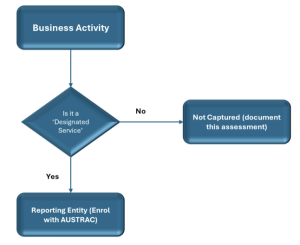
Diagram 2: Tranche 2 Decision Flow
⚙️ Step 2: Assess Operational Impact
AML/CTF affects more than policy documents.
It influences:
🧾 Client onboarding
🪪 Identity verification timing
👥 Beneficial ownership checks
🚨 Suspicious matter escalation
🗃 Record retention systems
Firms must redesign workflows — not just draft manuals.
🏛 Step 3: Elevate AML to Governance Level
AML compliance is a leadership responsibility.
Senior management must:
👤 Appoint an AML Compliance Officer
📊 Approve the ML/TF risk assessment
💼 Allocate implementation budget
📅 Oversee readiness milestones
📈 Step 4: Apply a Risk-Based Approach
AML/CTF is explicitly risk-based.
Risk increases where there is:
Controls must scale with risk.
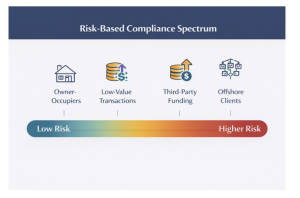
Diagram 3: Risk Based compliance Spectrum
As risk increases:
Step 5: Plan Backwards from July 2026
Effective readiness requires:
1️⃣ Capture confirmation
2️⃣ AUSTRAC enrolment
3️⃣ ML/TF risk assessment
4️⃣ AML/CTF program design
5️⃣ Workflow integration
6️⃣ Staff training
7️⃣ Readiness testing
Leaving this to late 2026 significantly increases operational strain.
Tranche 2 is not merely regulatory pressure.
It strengthens:
Firms that embed AML well will stand apart.
For real estate agents, lawyers, accountants, conveyancers and TCSPs:
AML is no longer theoretical.
It is approaching implementation.
The firms that act early will integrate compliance calmly and proportionately.
The firms that wait will react under pressure.
The difference will be visible.