Published on: March 24, 2026
Category: NDIS

The latest NDIS Quality and Safeguards Commission Quarterly Performance Report (Q2 2025–26) sends a clear message to disability service providers:
Compliance expectations are rising, and enforcement is becoming more active.
While the number of NDIS providers continues to grow, the Commission is also taking significant action against providers who fail to meet regulatory standards.
For providers, understanding these trends is critical to protecting registration and maintaining safe, compliant services.
1. 📊 Key Regulatory Statistics for Providers
Recent enforcement activity highlights the increasing regulatory focus on provider compliance.
Key figures from the latest quarter include:
⚖️ 117 provider registrations revoked
🚫 95 banning orders issued
📄 179 compliance notices issued
📈 26,282 registered providers nationally
The message from the regulator is clear:
Providers who fail to meet compliance obligations may lose their registration.
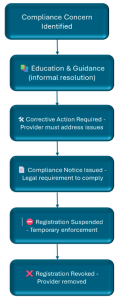
2. 🧭 How Providers Typically Lose Registration
Registration revocation rarely happens immediately. In most cases, enforcement follows a progressive escalation process.
Provider Enforcement Escalation Model
3. What this means for providers
Most enforcement actions escalate because providers:
✔ ignore regulatory guidance
✔ fail to implement corrective actions
✔ demonstrate ongoing risks to participants.
Early intervention is critical.
4. 🧩 The Most Common Compliance Failures
Analysis of complaints, incidents, and enforcement actions shows several consistent compliance risks across the sector.
A. 👥 Workforce capability and conduct
Many complaints relate to worker performance.
Common issues include:
⚠️ Staff lacking required training
⚠️ Poor supervision
⚠️ Workers failing to follow participant support plans
⚠️ Inappropriate behaviour or misconduct
Provider responsibility
NDIS providers must ensure workers:
✔ Are appropriately trained
✔ Understand participant needs
✔ Follow the NDIS Code of Conduct
B. 🏢 Weak governance and operational oversight
Governance failures are another common reason providers face regulatory action.
Examples include:
⚠️ Poor risk management systems
⚠️ Lack of leadership oversight
⚠️ Conflicts of interest not managed
⚠️ Poor operational procedures
Strong governance is one of the most effective ways to reduce regulatory risk.
C. 📑 Poor policies and procedures
Many providers underestimate the importance of strong documentation.
Common gaps include:
📄 Inadequate incident management policies
📄 Poor complaints handling systems
📄 Missing medication management procedures
📄 Outdated operational policies
These gaps can quickly escalate into serious compliance issues.
D. ⚠️ Incident Reporting: A Critical Compliance Risk
Providers must report certain incidents to the NDIS Commission.
These are called reportable incidents and include:
🚑 Serious injury
💥 Abuse or neglect
⚖️ Unlawful physical contact
⚠️ Death of a participant
Failure to report incidents correctly is one of the most common triggers for regulatory investigation.
E. 🛑 Restrictive Practices: A Major Regulatory Focus
Restrictive practices are closely monitored by the NDIS Commission.
These include:
🧪 Chemical restraint
🚪 Environmental restraint
🦾 Mechanical restraint
✋ Physical restraint
🔒 Seclusion
Unauthorised restrictive practices are considered a serious compliance breach.
F. 🧑🔧 Worker Screening Compliance
Providers must ensure workers in risk-assessed roles hold a valid NDIS Worker Screening Check.
Key responsibilities include:
✔ Verifying worker clearance before employment
✔ Monitoring expiry and suspensions
✔ Ensuring excluded workers are not engaged
Failure to comply can lead to enforcement action against the provider.
5. 🛠 What Providers Should Do Now
To reduce compliance risk, providers should focus on strengthening the following areas.
A. Governance
🏢 Establish strong leadership and oversight structures
📊 Monitor compliance risks regularly
B. Workforce capability
👩🏫 Provide ongoing training
👀 Ensure proper supervision of workers
C. Incident management
🚨 Implement clear incident reporting processes
📝 Maintain accurate incident documentation
D. Policies and procedures
📄 Keep operational policies updated
⚙ Ensure procedures are actually implemented in practice
E. Restrictive practice compliance
🧠 Ensure behaviour support plans are in place
📢 Report unauthorised practices correctly
6. 📌 Final Thoughts
The NDIS sector continues to expand, but regulatory expectations are increasing at the same time.
Providers who focus on:
✔ strong governance
✔ workforce capability
✔ incident management
✔ compliance systems
will be far better positioned to operate successfully in the current regulatory environment.
Ultimately, compliance is not just about avoiding sanctions — it is about ensuring safe, high-quality support for NDIS participants.