Published on: September 21, 2026
Category: NDIS

One of the things I have learned from working with NDIS providers is that some of the most useful compliance work starts after the policies, procedures, registers and systems are already in place. At that point, the questions change.
Are people using them as intended? Are the controls actually managing the risks they were designed to manage? Is the information being captured reliable? And is that information helping management understand what is happening across the organisation? These questions matter because a compliance process can exist, be followed and still not produce the outcome we expect.
Documentation provides the structure. The real test is whether that structure produces the intended outcome. This is often where ongoing NDIS compliance support becomes most valuable, well after the initial systems are built.
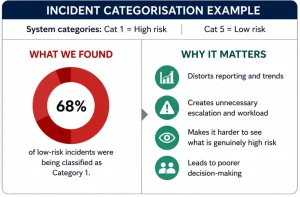
A provider I work with uses a system to record and manage incidents. The system includes built-in categories, with Category 1 representing high-risk incidents through to Category 5 for lower-risk incidents. The system was in place, staff were reporting incidents, incidents were being captured and management had access to the information.
When we looked at the incident data more closely, something stood out. A significant number of relatively low-risk incidents were being classified as Category 1.
The immediate response could be to remind staff of the procedure or provide more guidance. But first, it is worth understanding why the control isn’t producing the outcome we expected. Do staff understand the categories? Are they confident assessing risk? Is the wording within the system unclear? Are people choosing Category 1 because they believe selecting the highest category is the safest option?
If relatively minor incidents are routinely classified as high risk, the data management relies on becomes distorted. When everything appears urgent, it becomes harder to identify what genuinely requires attention. So something that initially looks like a data-entry problem can become a governance problem. Management needs reliable information to make good decisions.
Control effectiveness can sound unnecessarily technical. The concept itself is simple.
If we put something in place to manage a risk, is it actually doing what we expected it to do?
An incident classification process is a control. Worker screening is a control. Training is a control. Reviewing restrictive practices is a control. Escalating complaints is a control. Completing participant risk assessments is a control. The existence of the control is one question. Whether it works is another.
If a control isn’t working, adding another document may not address the reason. Sometimes people don’t understand the process. Sometimes responsibilities aren’t clear. Sometimes the system itself creates confusion. Sometimes training hasn’t translated into practice. Sometimes information is being captured but nobody is reviewing it. And sometimes a process that looked sensible when it was designed simply doesn’t work particularly well operationally.
A control should:
Imagine a participant tells a support worker that they are unhappy about something. The worker listens, resolves the issue and the participant is satisfied. Because nobody considers it a “formal complaint”, nothing goes into the complaints register.
Individually, this might seem reasonable. But imagine five participants raise similar concerns over several months and each is dealt with informally. Management sees a complaints register with very little activity, while participants are actually telling the organisation something important.
The issue isn’t necessarily the complaints policy. The information simply isn’t travelling through the organisation in a way that allows the pattern to be seen. The outcome we want is for concerns to be recognised, recorded and escalated appropriately so the provider can learn and improve.
Most providers have some form of risk register. What interests me more is what happens after a risk is recorded. If participant safety is identified as a significant risk, what is actually managing that risk day to day? What are the important controls? Who owns them? What would tell us that they aren’t working?
This is where incidents, complaints, audits, staff feedback and corrective actions become incredibly useful. An increase in incidents might tell us something about a risk already on the risk register. Several complaints might point to a control that isn’t working. An audit finding might help explain why the same issue keeps occurring.
These shouldn’t necessarily be viewed as separate compliance activities. When they are connected, compliance information starts becoming useful management information.
When reviewing a compliance process, I often work through this straightforward chain:
Obligation, Risk, Control, Operation, Evidence, Oversight, Improvement.
In practical terms:
You can apply these questions to incidents, complaints, worker screening, participant risk, restrictive practices, medication management, emergency management or almost any other area of an NDIS provider’s operations. It also helps move the conversation from “Do we have it?” to “Does it work?”
Incident reports, complaints, audit findings, training records, risk assessments and improvement actions are often thought of primarily as compliance evidence. They are evidence. But collectively, they can tell a much bigger story.
The value is in asking what the records are telling us.
As an NDIS provider grows, its directors and senior managers become further removed from day-to-day service delivery. They can’t see every incident, complaint, worker issue or participant interaction. They shouldn’t need to. Good governance depends on the right information making its way from operations to the people responsible for oversight.
Management should be able to understand:
This is why I don’t see compliance as something that sits separately from operations or governance. Done well, it connects them.
Policies, procedures, registers and systems give providers the structure they need. The next level is understanding whether that structure works once it meets the reality of day-to-day service delivery.
For me, one of the most useful questions we can ask of any compliance process is a simple one:
Is it actually producing the outcome we designed it to achieve?