Published on: September 21, 2026
Category: Aged Care

The introduction of the new Aged Care Act on 1 November 2025 has changed the regulatory environment for aged care providers in a significant way. Among those changes is the move to time-limited provider registration and periodic renewal.
For existing providers transitioned into the new framework, registration end dates have been staggered. As renewal dates approach, many providers will understandably turn their attention to audit readiness, policies, procedures and evidence.
All of that is important. But I think there is a bigger question providers should be asking: Can we demonstrate that our systems are actually working?
For providers whose renewal involves an audit against the strengthened Aged Care Quality Standards, the focus goes well beyond whether the right documents exist. Auditors can look at how systems are implemented in practice, how older people experience care and services, and whether the provider can demonstrate that its arrangements are producing the intended outcomes.
That distinction matters. A provider can have a comprehensive suite of policies and still have weaknesses in how risk is managed, how quality issues are identified, how clinical performance is overseen, how consumers influence decisions, or how information reaches the governing body. Renewal readiness therefore needs to look at the organisation behind the documents. This is often where structured aged care compliance support makes the difference.
From the work we have been doing with aged care providers, some common themes continue to emerge. Some of the recurring areas we see warranting closer attention include governance, risk management, quality management, clinical governance, consumer partnership and co-design, and evidence of implementation. This is not an exhaustive list. Every provider is different, and there will be other risks, gaps and improvement opportunities depending on the organisation, its services and how its systems operate in practice.
Most established providers will already have policies and frameworks covering the major areas of their operations. The important thing is to look beyond whether the framework exists and test whether it is actually working as intended.
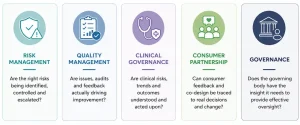
Audit preparation is an opportunity to bring together the evidence that demonstrates how the organisation operates in practice. Policies, registers, meeting minutes, training records and other supporting information all contribute to that picture. In a mature system, much of this evidence is already being generated through normal operations, making the audit a process of demonstrating how the system works rather than preparing evidence specifically for the audit.
Consider incident management. An incident register showing that 32 incidents occurred during the month tells us something. But by itself, it tells us very little about whether the organisation is managing those incidents effectively.
A stronger system might identify that 18 of those incidents were falls, that falls have increased for three consecutive months, that they are concentrated within particular services and that several share common contributing factors.
The organisation can then demonstrate what it did with that information: risks were reassessed, actions were allocated, relevant practices were reviewed, the issue was escalated through the appropriate governance structure and subsequent performance is being monitored.
That is a very different form of evidence. It demonstrates not simply that an incident management process exists, but that the organisation is learning and responding.
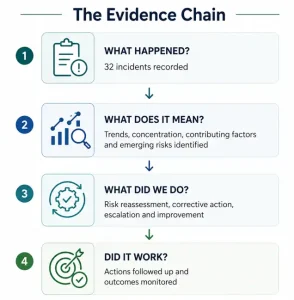
The same logic should be visible across complaints, clinical indicators, workforce issues, internal audits, consumer feedback, risk management and continuous improvement. Good systems create their own evidence.
Governance is what provides oversight across risk, quality, clinical governance, consumer experience and the broader operations of the organisation. But effective oversight depends on the governing body receiving information that helps it understand not just what has happened, but what it means and whether the organisation is responding appropriately.
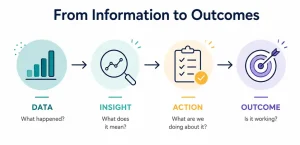
The incident example above illustrates the difference. Reporting the number of incidents provides information. Explaining the trends, contributing factors, emerging risks, actions being taken and whether those actions are working provides insight.
The same principle applies across complaints, clinical indicators, workforce, consumer feedback, audit findings, risk and continuous improvement. Governing bodies do not necessarily need more information; they need the right information, with sufficient context to identify what matters, ask the right questions and provide appropriate challenge and oversight.
This is where structured and insightful reporting becomes important. Good reporting should connect performance, risk, action and outcomes, rather than presenting a collection of disconnected metrics. In many organisations, the opportunity may therefore be less reporting, but better reporting.
The same principle applies to consumer engagement and co-design. Having a Consumer Advisory Body, satisfaction survey, complaints process or resident meeting does not automatically demonstrate meaningful partnership.
The stronger question is: What changed because older people were involved?
Providers should be able to trace the journey from consumer voice through consideration, decision and, where appropriate, implementation. That might be a change to dining arrangements following resident feedback, redesign of information with consumers to make it more accessible, changes to activities or routines, improvements arising from complaints, or older people being directly involved in the design of a service or process.
Not every piece of feedback will result in change. Nor should it. But there should be evidence that consumer input is genuinely heard, considered and connected to decision-making. That is the difference between engagement as an activity and partnership as a way of operating.
One of the most useful things providers can do before renewal is look at whether their systems connect.
A complaint may identify a quality issue, which in turn changes the organisation’s risk profile. That may require corrective action and become part of the continuous improvement program. Consumer input may help shape the response, while quality monitoring or internal audit subsequently tests whether the change has been implemented and is effective. Depending on its significance, the issue may also require clinical governance consideration and visibility at governing body level.
These should not operate as isolated compliance processes. A mature organisation connects the dots. That interconnectedness is also what makes evidence more convincing. Instead of presenting isolated registers and meeting minutes, the organisation can demonstrate how an issue moved through its systems from identification to response, oversight and outcome.
There is one question I think providers can use to challenge themselves: If the audit commenced tomorrow, would the evidence already exist?
If the answer is yes, audit preparation becomes considerably easier because the evidence is being generated through normal operations. If significant evidence needs to be recreated shortly before the audit, that may point to something more important than an evidence gap. It may indicate that the underlying system has not been operating consistently.
Registration renewal will inevitably involve documentation, evidence gathering and audit preparation. But there is an opportunity to use the process for something more valuable: to test whether the organisation’s systems are genuinely operating as intended.
Do governance, risk, quality, clinical governance, workforce and consumer partnership operate as connected systems? Does information lead to insight? Does insight lead to action? And can the organisation demonstrate whether those actions are improving outcomes for older people?
Because ultimately, policies establish expectations. Systems put them into practice. Evidence demonstrates they are working. Outcomes show whether they are making a difference. That is a much stronger measure of registration renewal readiness than the size of an evidence folder.